

 English
 русский
 中文简体
中文简体 Español

MTD Cub Cadet Gator Blade Factory Guide: OEM vs. Aftermarket, Specs & Performance
Sep 04, 2026
The morning after mowing, you notice it: streaks of clippings littering the lawn, brownish patches where grass was torn rather than cut, and a nagging feeling that your mower could do more. You have been using standard replacement blades, assuming they are all the same. But what if the blade itself is the ceiling on your mower’s performance?
This is where the MTD high lift blade conversation begins, but the real leap forward comes from a different design philosophy—one that treats the blade as an active participant in turf health, not just a spinning steel bar. The MTD Cub Cadet Gator Blade represents this shift: it is not a replacement, it is an upgrade. Designed with factory-grade precision, it redefines what a mower deck can accomplish, especially on 42-inch and larger cutting platforms.
Blade Length21-3/16"
Center Hole5/8" Star
Thickness0.187"
Fitment42" Decks
The term "factory" often conjures images of assembly lines and bulk packaging, but in the mower blade world, it signals something more important: engineering that matches the deck's airflow dynamics. Aftermarket blades that ignore these parameters can reduce lift, increase clumping, and leave you bagging for twice as long. The Gator design, however, starts with factory specifications and then improves upon them—delivering a balance of cutting efficiency and soil enrichment that standard blades cannot match.
MTD Cub Cadet Blade Specifications – Technical Deep Dive
Compatibility is the first hurdle. You need to know that the blade you install will not only bolt on but also perform within the deck's engineered airflow envelope. The 42-inch deck is the most common platform for residential and light-commercial mowers, and the Oregon 98-629 serves as the reference standard for this size class.
42-Inch Deck Specifications (Primary Fitment)
MPN Reference: Oregon 98-629 (also cross-referenced with 742-0616, 942-0616, 742-05067, 742-04053)
Blade Length: 21-3/16 inches – this is the total tip-to-tip measurement when the blade is lying flat
Center Hole: 5/8-inch six-point star drive – this is critical; using a blade with a different hole shape can cause vibration and premature spindle wear
Thickness: 0.187 inches – heavier than many economy blades, which reduces flex at high RPM and extends edge retention
| Model Reference | Deck Size | Blade Length | Center Hole |
|---|---|---|---|
| 742-0616 / 942-0616 | 42" | 21-3/16" | 5/8" Star |
| 742-05067 | 42" | 21-3/16" | 5/8" Star |
| 742-04053 | 42" | 21-3/16" | 5/8" Star |
Variant Fitments – 46" and 50" Decks
For larger cutting decks, the blade dimensions shift. The 96-401 variant measures 23-1/4 inches and fits 46-inch decks, but with an important caveat: it is not compatible with post-2014 stamped decks, which use a different spindle offset. For 50-inch decks, the 50MGS1G33 kit provides a matched set of three blades, each engineered to maintain overlap and lift uniformity across the wider cutting swath.
46-inch deck: 96-401 (23-1/4") – verify deck manufacturing year before ordering
50-inch deck: 50MGS1G33 – three-blade system with matched weight and pitch
Always confirm: spindle rotation direction and center hole geometry before purchase
Key Insight: The 42-inch deck is the sweet spot for Gator blade performance because the deck depth and spindle speed create the ideal air volume for the patented tooth-twist design to function fully.
Gator Technology – The Factory Engineering Behind the Cut
The Gator blade series, engineered by Oregon, is not a generic mulching blade. It is a factory-grade upgrade that uses a patented Tooth-Twist design. The blade features upward-curved teeth at the tip and a twisted airfoil section along the body. As the blade rotates, these teeth capture grass clippings and redirect them upward into the deck chamber, where they are struck multiple times before exiting.
How the Tooth-Twist Design Works
First cut: The primary cutting edge shears the grass at the standard height
Second cut: The twisted section lifts the clipping and accelerates it upward
Third cut: The teeth at the tip strike the clipping against the deck baffle, fragmenting it into smaller pieces
Final discharge: The finely mulched material drops into the turf canopy, where it decomposes and returns nitrogen to the soil
This multi-strike process reduces the average clipping size from 2-3 inches to less than 0.5 inches, which is the threshold for rapid microbial breakdown. Field observations show that lawns mowed with Gator-style blades require 30-40% fewer bagging stops compared to standard high-lift blades, and side-discharge clumping is significantly reduced because the particles are too fine to aggregate.
Bagging Frequency -35% vs. standard blades
Clipping Size Below 0.5" for rapid breakdown
Real-World Feedback and Trade-offs
User reports from lawn care forums consistently highlight two points. First, the tooth design excels at shredding dry leaves in the fall—many describe it as a "leaf shredding tool" that reduces raking time by more than half. Second, the blade's lift characteristic is slightly lower than a dedicated high-lift blade, which means that in wet or dense grass, the discharge may not carry clippings as far. This is not a defect; it is a design choice that prioritizes cutting quality over throwing distance.
Advantage: Exceptional mulching of dry grass and leaves; reduced bagging; healthier turf
Trade-off: Slightly reduced lift in wet conditions; may require a second pass if grass is overgrown
User tip: Maintain a sharp edge and clean the deck regularly to maximize lift
How to Select and Source Factory-Grade Blades
The word "factory" carries weight in the replacement parts market. It signals that the blade meets the original equipment manufacturer's dimensional and metallurgical standards. However, not all blades labeled as "OEM compatible" are created equal. Here is how to distinguish genuine factory-grade stock from lower-tier alternatives.
Identifying Authentic Oregon Gator Blades
Packaging: Genuine Oregon packaging includes a holographic seal and a batch number that traces to the production facility
Steel stamping: The blade surface has "Oregon" and the part number laser-etched near the center hole
Edge geometry: The tooth profile is uniformly ground, with no burrs or asymmetrical grinds
Weight consistency: A 21-inch Gator blade weighs within 5 grams of the spec sheet value; cheap copies are often lighter
Price Reference and Value Indicators
| Blade Size | Typical Price Range (USD) | Notes |
|---|---|---|
| 21" (42" deck) | $30 – $50 per set | Two-blade set |
| 23-1/4" (46" deck) | $35 – $55 per set | Two-blade set |
| 50" deck kit | $60 – $85 per kit | Three-blade matched set |
Bulk pricing is available for landscapers and fleet operators. If you manage multiple mowers, the per-unit cost drops significantly when ordering directly from a factory-grade supplier. As a factory-grade supplier, we offer wholesale pricing for bulk orders. Contact us for the latest quotation.
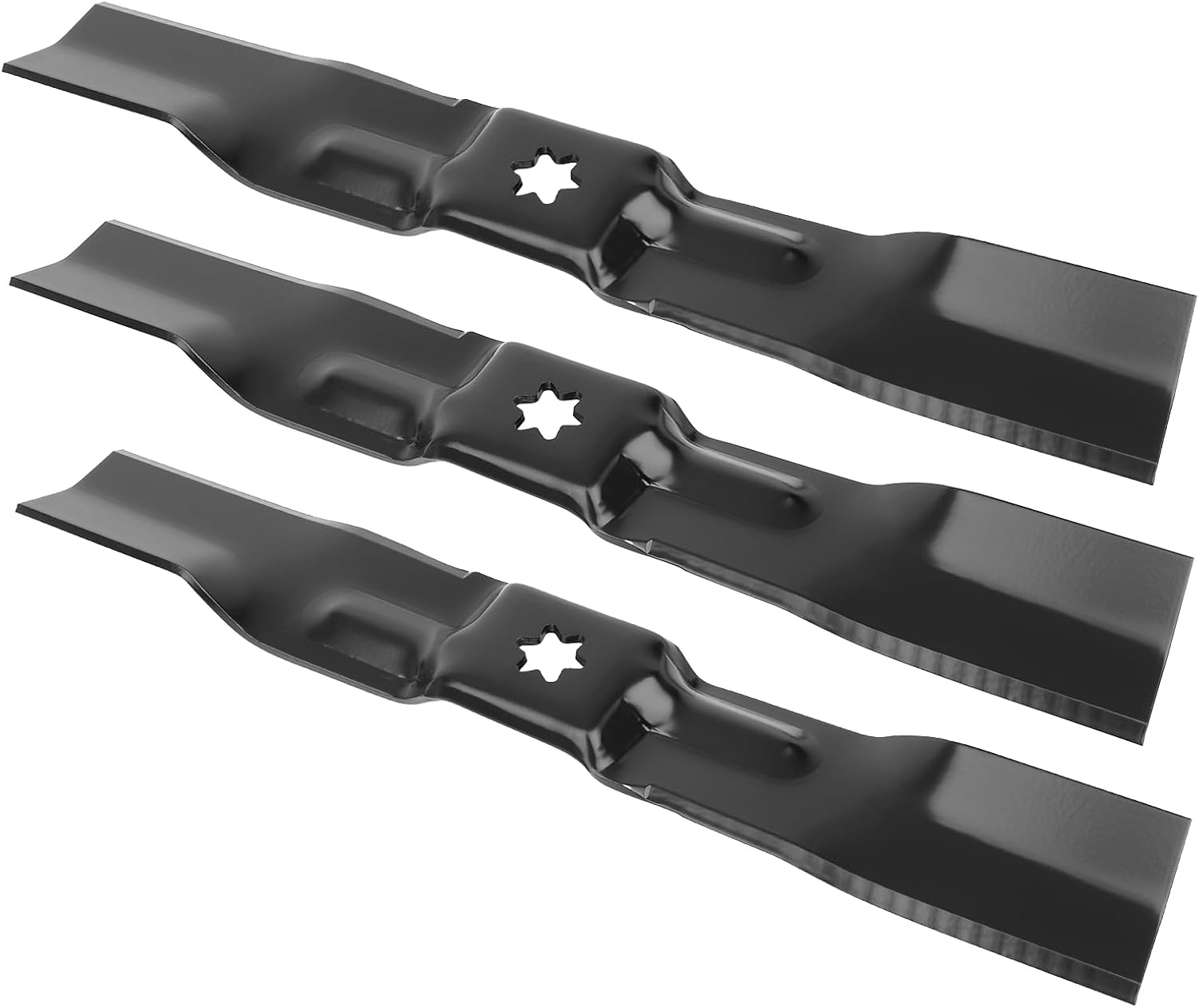
When evaluating a supplier, ask about the steel grade (typically high-carbon spring steel with a Rockwell hardness of 48-52 HRC) and the coating process. Factory-grade blades often have a anti-corrosion coating that extends service life, especially in humid climates.
Frequently Asked Questions About MTD Cub Cadet Gator Blades
Q1: Can I use the Gator blade on my Cub Cadet RZT SX 42?
Yes, the Gator blade with the 21-3/16 inch length and 5/8 inch star center hole is fully compatible with the RZT SX 42 and RZT SX 42 EFI models. Always confirm that your deck uses the star-drive spindle and not an older round-hole design.
Q2: Is the Gator blade effective for shredding dry leaves in autumn?
Absolutely. The tooth-twist geometry excels at fragmenting dry leaves into fine particles. Many users report that a single pass with a Gator blade reduces leaf volume by 80%, eliminating the need for raking or vacuuming.
Q3: Why does my mower seem to have less airlift after installing the Gator blade?
The Gator blade prioritizes cutting and mulching over high-lift discharge. It generates enough airflow to suspend clippings for re-cutting, but it does not throw clippings as far as a dedicated high-lift blade. This is normal and indicates the blade is functioning as designed. For wet or tall grass, slow down your ground speed to allow the blade more time to process the material.
Q4: How often should I sharpen the Gator blade?
For residential use, sharpening every 20-25 mowing hours is recommended. For commercial use, inspect the edge weekly and sharpen when the cutting edge becomes rounded. The thicker 0.187-inch steel allows for multiple sharpenings before the blade needs replacement.
Q5: Will the Gator blade fit a 46-inch stamped deck from 2015?
The 96-401 (23-1/4 inch) blade is not recommended for post-2014 stamped decks because the spindle offset changed. For those decks, consult your mower's parts manual for the correct blade part number. The 42-inch version, however, remains compatible across most manufacturing years.
Contact Us And Get A Quote
Priority To Learn About Our New Products
 Add: North of Guo'an Road, Economic Development Zone, Guangde County, Anhui,China
Mob: +86-13967663706
E-mail: [email protected]
Add: North of Guo'an Road, Economic Development Zone, Guangde County, Anhui,China
Mob: +86-13967663706
E-mail: [email protected]
Copyright © 2025 Anhui Boxing Machinery Co., Ltd All Rights Reserved.China Custom Industrial-Grade Mower Blades Manufacturers
