

 English
 русский
 中文简体
中文简体 Español

Best Lawn Mower Blade for Bagging: How High-Lift Design Boosts Airflow and Collection
Oct 01, 2026
Bagging grass clippings is one of the most demanding jobs a lawn mower can perform. The cutter deck must slice the grass cleanly, generate enough airflow to lift the clippings, carry them through the discharge chute, and pack them evenly inside the catcher. When the blade is not matched to that task, the signs are obvious: clogged chutes, half-filled bags, clumps dropped on the lawn, and repeated stops to clear the deck.
The blade works as both a cutting tool and an air pump. For bagging, the air-pump role matters just as much as the cutting role. A blade with weak lift cannot keep clippings suspended long enough to reach the catcher, no matter how sharp it is. This is why the blade profile is the first thing to evaluate whenever bagging performance falls short.
This guide explains the blade geometry that drives successful bagging, compares the main blade types used with grass catchers, and provides practical recommendations for choosing, fitting, and maintaining the best lawn mower blade for bagging on your mower.
Why Blade Design Determines Bagging Performance
Airflow inside a mower deck follows a simple mechanical principle: the rotating blade acts like an impeller, pulling air upward from beneath the deck and pushing it outward toward the discharge opening. Grass clippings travel inside that air stream. When air velocity drops below a critical level, the clippings settle, accumulate, and eventually block the chute. Three design features control how much air a blade can move:
Sail height: the bent vertical surface at the trailing edge of each wing. Higher sails generate more upward air velocity.
Wing length: longer wings move air across a wider arc, which improves the forward velocity that carries clippings toward the chute.
Blade angle: the upward bend angle of the wings, typically 15 to 30 degrees, determines how aggressively the air is deflected.
The relationship between these features is not linear. A very high sail on a short wing creates pressure in one small area without sustaining the wide air stream that a bagger needs. A long wing with almost no sail angle moves a lot of air but directs very little of it upward. The best bagging blades balance sail height and wing length so that the air stream stays strong from the center of the deck to the chute opening.
Bagging blades need strong airflow across the full operating range, including reduced throttle. Many homeowners slow down when turning or when they approach obstacles, and a blade that only develops lift at full speed will leave clippings behind or cause the chute to clog. High-lift blades are engineered with a steep sail angle and maximum wing area for exactly this reason. Commercial crews and mower manufacturers overwhelmingly choose high-lift designs for bagger-equipped machines.
The consequences of weak airflow are visible within the first pass. Grass clippings fall back onto the uncut strip, the chute opening accumulates a wet mat, and the operator has to lift the deck to clear the blockage. Over time, the extra stops and clumps create a ragged lawn surface that takes days to recover.
The deck shell also plays a role. Baffles and the chute opening direct the air stream, and they are shaped around the blade type specified by the manufacturer. If you replace a high-lift blade with a much lower-profile design, the air stream changes and the deck no longer produces the vacuum needed to keep the bagger full. Upgrading back to a high-lift blade is often the simplest way to restore proper airflow balance.
Figure 1: Airflow path produced by a high-lift blade inside a bagging deck.
Comparing Blade Profiles for Bagging
Different blade designs solve different mowing problems. The table below compares the profiles that appear most often in bagging discussions. Ratings reflect typical behavior on residential decks from 42 to 61 inches with a removable grass catcher.
| Blade Profile | Lift Strength | Best Use | Bagging Performance | Main Limitation |
|---|---|---|---|---|
| High-lift | Strong | Bagging, side discharge | Excellent | High power draw |
| Standard lift | Moderate | General cutting | Good in dry grass | Weak in heavy clippings |
| Low-lift | Weak | Dry and dusty sites | Poor | Low airflow |
| Mulching | Low to moderate | Grass recycling | Fair | Frequent clogging |
| Gator-style | Moderate to strong | Leaves, mixed use | Very good | Faster edge wear |
The ratings above assume a clean deck with proper blade orientation and a sharp edge. Any of these factors can shift the result by a full category. A dull high-lift blade may bag worse than a sharp standard blade, because the ragged cut produces longer strands that tangle at the chute entrance.
High-lift blades: the first choice for bagging
High-lift blades are the most effective profile for bagging grass and leaves. Their tall sails act like fan blades, producing a strong vacuum under the deck and a high-velocity stream into the chute. Typical high-lift sails rise 20 to 30 degrees above the cutting plane, and the trailing edge extends well behind the cutting edge so that air is forced upward continuously as the blade rotates. They handle thick, fast-growing grass better than any other profile, and they are the standard original-equipment choice for most bagger systems. Operators who want to understand how this profile affects deck performance can read more about how to improve mowing efficiency with high-lift blades.
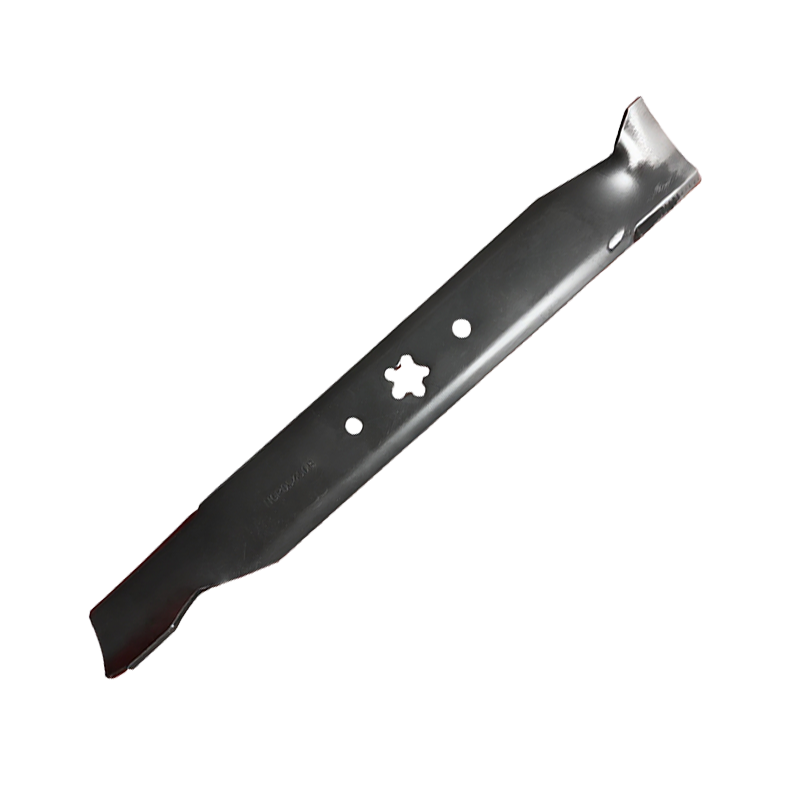 138496 AYP/Husqvarna High-Lift Blade for Bagger SystemsThis high-lift blade generates strong vacuum under the deck, ideal for bagging thick grass and leaves. Its tall sails push clippings through the chute effectively, making it a standard choice for bagger setups.View Product →
Gator-style blades: a strong compromise
Gator-style blades combine a serrated cutting edge with a medium-to-strong lift wing. The serrated edge acts like a series of small cutters, so clippings break into short pieces that flow through the chute instead of matting at the entrance. This reduces clogging and lets the catcher hold more material by weight. Gator-style blades are excellent for autumn leaves and work well when the same mower is used for both bagging and mulching. The main drawback is faster wear of the serrated edge in abrasive or sandy soil. A gator-style blade is a good choice if bagging is only part of your mowing schedule.
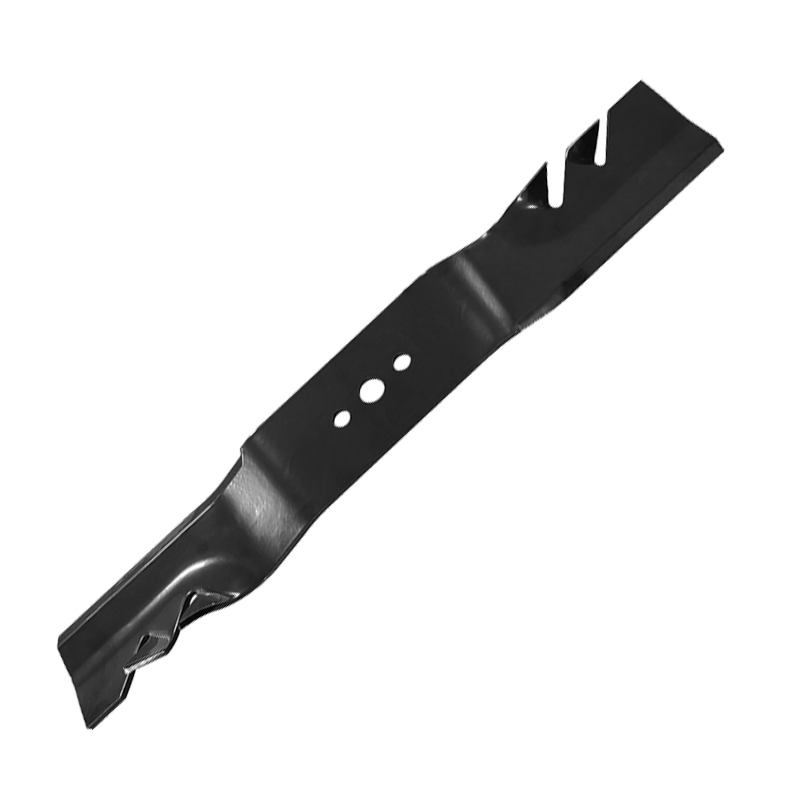 505 54 45-01 Husqvarna/Jonsered Gator Blade for Bagging and MulchingThe Gator-style serrated edge cuts clippings into short pieces to reduce clogging in the chute. It works well for both bagging and mulching, especially when the same mower handles fall leaves.View Product →
Mulching and low-lift blades: why they struggle with baggers
True mulching blades are designed to keep clippings circulating under the deck for repeated cutting. They produce a rolling air pattern inside the deck instead of a strong outward stream, so they lack the air velocity needed to push material through a bagger chute. When installed with a catcher, mulching blades tend to clog in wet or thick grass and leave the bag loosely filled. Low-lift blades minimize dust and fuel consumption on dry terrain, but their weak airflow makes them a poor match for any bagging application. Neither profile should be your first choice when the grass catcher is installed.
Choosing the Best Blade for Your Bagger Setup
The best lawn mower blade for bagging depends on how often you bag, what you are collecting, and how powerful your mower is. Use the following guidance to narrow down the options.
Bag at every mowing: choose a high-lift blade. Consistent collection matters more than any other factor, and high-lift delivers the strongest airflow.
Collect leaves in autumn: choose a gator-style blade. The serrated edge chops leaves so they pack tighter and clog less often.
Alternate between bagging and mulching: keep a gator-style blade installed all season. It handles both tasks acceptably and avoids the need to change blades.
Small engine or electric mower: choose a medium-lift blade to limit the power lost to airflow drag. A full high-lift blade may reduce run time on battery mowers.
Tall or weedy grass: choose a high-lift blade and mow in narrower passes. The extra airflow keeps debris moving even under heavy load.
Engine power is the practical ceiling. A high-lift blade on a low-horsepower mower can bog down in tall grass because the engine cannot maintain rated blade speed. If the mower struggles when the blade is engaged, step down to a gator-style profile instead of accepting a constant power loss.
Deck size also matters. Larger decks need blades that move a higher volume of air, which is why 48-inch and wider mowers benefit most from a true high-lift profile. On smaller decks, the distance from blade to chute is shorter, so a standard or gator-style blade may be enough.
Grass condition remains the variable that overrides all others. Wet grass is the hardest material to bag because it sticks to the deck roof and clumps inside the chute. In wet conditions, a high-lift blade combined with slower ground speed gives the best result, but no blade eliminates the need to empty the bag more often.
If you bag dry, well-maintained turf, a standard blade still performs at an acceptable level. But if your lawn grows fast, if you bag infrequently, or if you collect leaves, the high-lift profile is the right direction. For a reliable match, always confirm the blade length, center-hole shape, and sail orientation before purchase.
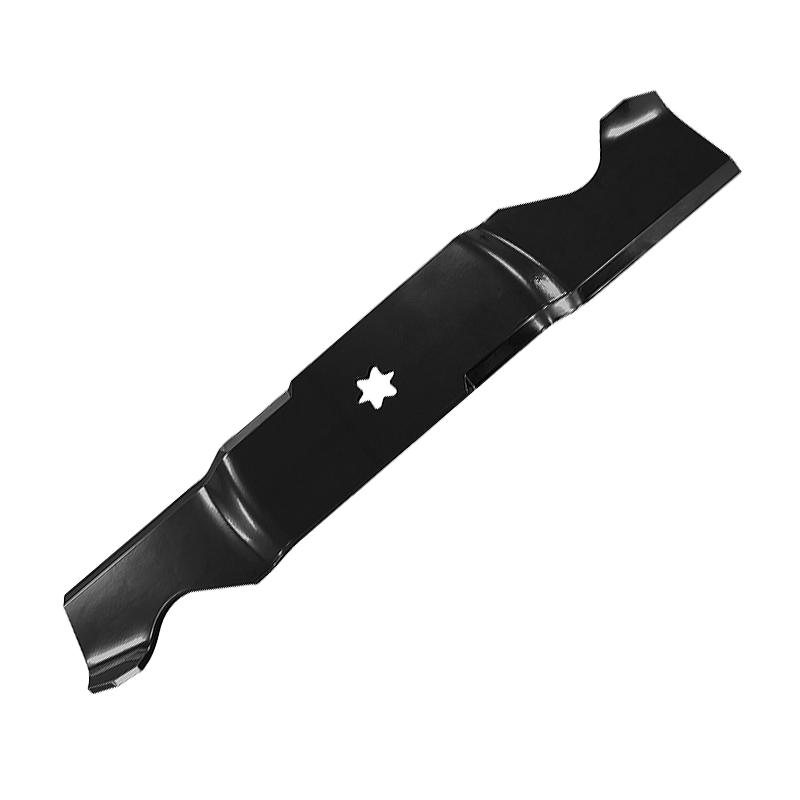 742-04053 MTD/Cub Cadet High-Lift Blade for Bagger PerformanceThis high-lift blade is designed for reliable bagging in fast-growing or wet turf. To avoid clogging, verify blade length, center hole shape, and sail orientation before installation.View Product →
Fitting, Installing, and Maintaining Bagging Blades
Correct installation and maintenance affect bagging performance just as much as the blade profile itself. A high-lift blade that is dull, unbalanced, or installed upside down will clog just like a low-lift blade.
Verify the blade dimensions first
Before buying a replacement, measure three things: blade length, center-hole shape, and blade offset. The blade length must match the deck specification; too short a blade reduces airflow, and too long a blade can contact the deck shell. Center-hole shapes include round, star, double-key, and offset oval, and the hole must fit the spindle adapter exactly. Offset or dished blades place the cutting edges at a specific height under the deck; if you install an offset blade in the wrong orientation, it loses all lift.
Install the blade with the sails facing upward
The most common installation error is upside-down orientation. The sails must face upward toward the deck. When they face downward, the air stream reverses and the catcher will not fill. Tighten the center bolt with a torque wrench to the value printed in the mower manual, then confirm that the blade spins freely and does not touch the deck shell or baffles. Always disconnect the spark plug wire before working under the deck, and wear heavy gloves.
Keep the edge sharp and the deck clean
Bagging performance drops sharply with a dull edge. Sharpen the blade every 20 to 25 hours of mowing, or more often when mowing over sandy soil. Always balance the blade after sharpening; vibration from an unbalanced blade disrupts the airflow and shortens the spindle bearing life. Clean grass buildup under the deck after every use, because a thick layer restricts the air passage and reduces the vacuum that carries clippings to the bag.
Replace blades on a regular schedule
Replace the blade when the cutting edge has worn back by more than about 3 mm, when the sail is bent, when the blade no longer balances, or after any hard impact with a rock, stump, or curb. Repeated sharpening changes the blade geometry over time, so a blade that has been sharpened more than three or four times is usually ready to be retired. When you replace it, check the complete line of OEM-compatible replacement blades to find the correct part number for your deck.
At the end of the season, remove the blade, clean it, and inspect the center hole for elongation. Store the mower with a dry deck to prevent rust and corrosion. A corroded blade develops a rough trailing edge, which reduces lift even when the cutting edge is sharp.
Frequently Asked Questions
Short answers to the questions operators ask most often when they set up a mower for bagging.
Q1: What is the best lawn mower blade for bagging grass?
For most mowers, a high-lift blade is the best choice for bagging. The tall, angled sails generate strong airflow that carries clippings through the chute and into the bag, even in thick grass. Gator-style blades are the best alternative when you also mulch part of the season.
Q2: Can I use a mulching blade with a grass catcher?
You can, but it will clog more easily. Mulching blades are designed to keep clippings under the deck for recutting rather than pushing them out the chute. Use a mulching blade with a bagger only in dry, short grass; switch to a high-lift or gator-style blade for reliable collection.
Q3: How do I know which blade size fits my mower?
Check the blade length and the center-hole shape against your old blade or the equipment manual. The tip-to-tip length must match the deck size, and the center hole must fit the spindle adapter. When in doubt, locate the original part number stamped on the blade and search for a direct replacement.
Q4: Why does my bagger clog even after I installed a new high-lift blade?
The most common causes are incorrect blade orientation, a dull cutting edge, debris buildup under the deck, or a bent deck baffle. Check that the sails face upward, sharpen the blade, clean the deck underside, and inspect the baffles and chute opening for damage. Raising the deck to a slightly higher cutting height can also help in wet grass.
Q5: How often should bagging blades be replaced?
Replace the blade when the cutting edge shows more than 3 mm of wear, when the sail is deformed, or when sharpening no longer restores balance. Most residential operators replace bagging blades once per season, while commercial crews change them monthly or sooner depending on use.
Contact Us And Get A Quote
Priority To Learn About Our New Products
 Add: North of Guo'an Road, Economic Development Zone, Guangde County, Anhui,China
Mob: +86-13967663706
E-mail: [email protected]
Add: North of Guo'an Road, Economic Development Zone, Guangde County, Anhui,China
Mob: +86-13967663706
E-mail: [email protected]
Copyright © 2025 Anhui Boxing Machinery Co., Ltd All Rights Reserved.China Custom Industrial-Grade Mower Blades Manufacturers
