

 English
 русский
 中文简体
中文简体 Español

What Makes a Good Lawn Mower Blade? Key Features Explained
May 15, 2026
A well-maintained lawn starts from the ground up, but the component that directly determines grass health and appearance is often overlooked: the lawn mower blade. While many homeowners focus on engine power or deck size, the blade is the only part that physically interacts with every grass plant. A poor blade tears rather than cuts, leaving frayed tips vulnerable to disease. A high-quality blade delivers a clean, precise shearing action that promotes rapid healing and a manicured look. Understanding what makes a good lawn mower blade requires examining metallurgy, geometry, balance, and maintenance factors.
The Core Function: Cutting Versus Tearing
Before exploring materials and shapes, it is essential to understand the mechanical distinction between a true cut and a tear. Grass blades are composed of cellulose fibers bundled together. A sharp, well-designed lawn mower blade strikes these fibers with enough localized pressure to sever them cleanly. In contrast, a dull or poorly shaped blade impacts the grass with a blunt edge, crushing and ripping fibers apart. The resulting ragged tip loses moisture rapidly, often turning brown within days. Frequent tearing weakens the lawn, inviting fungal infections and weeds. Therefore, every feature discussed below ultimately serves one goal: enabling a clean, low-friction cut with each rotation.
Steel Composition and Hardness
The foundation of any durable lawn mower blade is the steel alloy. Most blades are stamped from hot-rolled or cold-rolled steel sheets, but the specific carbon content and heat treatment determine longevity.
Carbon steel (typically 0.45%–0.60% carbon) is the industry standard. It can be hardened to a Rockwell rating of 40–50 HRC, offering a balance between edge retention and impact resistance. Too soft, and the blade dulls quickly; too hard, and it becomes brittle, cracking upon striking a rock or root.
High-carbon steel (above 0.60% carbon) reaches higher hardness levels (50–55 HRC), holding an edge longer. However, it requires careful tempering to avoid brittleness. Such blades are often found in professional-grade equipment.
Abrasion-resistant alloys may include small amounts of silicon, manganese, or boron to improve wear resistance without sacrificing toughness. These materials resist dulling from sandy soils or frequent mowing.
A good lawn mower blade should resist bending upon impact. A bent blade creates vibration and uneven cutting. Quality manufacturers use full hardening followed by tempering to achieve a microstructure of tempered martensite, which provides both strength and slight flexibility. Table 1 summarizes the relationship between steel type and expected performance.
| Steel Type | Typical Hardness (HRC) | Edge Retention | Impact Resistance | Best Use Case |
|---|---|---|---|---|
| Low-carbon (mild) | 25–35 | Poor | High | Occasional light mowing |
| Medium-carbon | 35–45 | Fair | High | Residential weekly mowing |
| High-carbon | 45–52 | Good | Moderate | Frequent mowing, tough grasses |
| Abrasion-resistant | 50–55 | Excellent | Moderate | Sandy or gritty conditions |
Blade Geometry and Profile
Shape determines how air moves beneath the deck and how the edge meets each grass stem. A lawn mower blade is never a simple flat bar; it incorporates specific geometric features that enhance cutting efficiency.
Lift and Wing Design
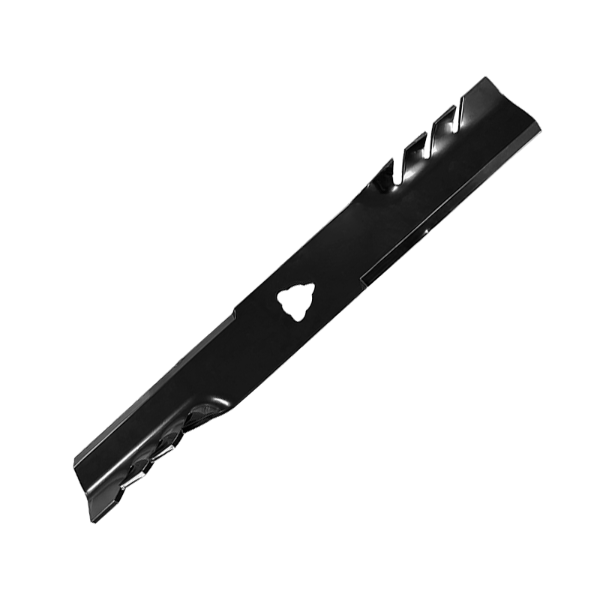
Most rotary mower blades have curved upward wings near the ends. This curvature, called “lift,” serves two functions. First, it creates an updraft that pulls standing grass into the cutting path. Second, it accelerates clippings toward the discharge chute or into a collection bag. Lift is classified as low, medium, or high:
Low lift (flat or nearly flat blade): Minimal updraft. Used on mulching mowers or sandy conditions where high lift would ingest dust. Produces fine clippings but may leave some grass uncut.
Medium lift (moderate upward curve): Balanced performance for residential lawns. Lifts grass sufficiently while consuming moderate engine power.
High lift (pronounced wing angle): Maximum air movement. Ideal for tall or wet grass, and for bagging clippings. However, high-lift blades require more horsepower and wear faster.
A good lawn mower blade matches lift to typical mowing conditions. Using a high-lift blade on a low-powered mower can cause engine lugging and poor cut quality.
Cutting Edge Bevel
The edge bevel—the angled ground surface that forms the cutting tip—determines how easily the blade penetrates grass. Two common bevel configurations exist:
Single bevel (one side ground, the other flat): Found on standard blades. The flat side aligns with the direction of rotation, and the beveled side faces upward. This design is simple and easy to sharpen.
Double bevel (both sides ground at a steeper angle): Creates a narrower edge profile, reducing cutting resistance. These blades are often marketed as “high-performance” because they require less engine torque. However, they dull slightly faster and demand careful sharpening.
The bevel angle typically ranges from 30 to 45 degrees. A shallower angle (30°) gives a sharper feel but is more prone to rolling over upon hitting debris. A steeper angle (45°) is more durable but requires higher rotational speed to cut effectively.
Balance: The Silent Performance Killer
Even the sharpest lawn mower blade will ruin a lawn if it is out of balance. Imbalance occurs when one side of the blade is heavier than the opposite side, causing the entire mower to vibrate at high speed. Sources of imbalance include:
- Uneven sharpening (more metal removed from one cutting edge)
- A bent blade from striking an obstacle
- Manufacturing variations in steel thickness
- Accumulated uneven wear or corrosion
Vibration from an unbalanced blade transfers to the mower deck, crankshaft, and bearings. Over time, this can loosen fasteners, crack the deck, and damage the engine’s output shaft. More immediately, an unbalanced blade produces a wavy, scalped cut because the blade does not rotate in a single plane. Grass height varies with each revolution, leaving an uneven appearance.
Proper balance can be tested with a simple conical balancer or a wall-mounted pin. The blade should remain horizontal in any orientation. If one side drops consistently, material must be removed from the heavier side—never added. When sharpening a lawn mower blade, always remove equal amounts from both cutting edges to preserve factory balance. Table 2 outlines common imbalance symptoms and causes.
| Symptom | Likely Cause of Imbalance | Remedy |
|---|---|---|
| Excessive mower vibration | Uneven sharpening or bent blade | Rebalance or replace blade |
| Wavy, irregular cut height | Blade wobbling out of plane | Check balance; replace if bent |
| Premature bearing failure | Long-term imbalance stress | Replace bearings and balance blade |
| Deck cracks near spindle | Severe imbalance over many hours | Weld deck and always use balanced blade |
Coatings and Corrosion Resistance
Moisture from morning dew, irrigation, and wet grass accelerates rust. Rust pits a lawn mower blade, creating microscopic jagged edges that tear grass fibers. Furthermore, thick rust adds surface roughness, increasing friction and reducing cutting efficiency. To combat corrosion, manufacturers apply various coatings:
Powder coating: Thick, polymer-based finish applied electrostatically. Durable against chipping but adds thickness that can affect balance if uneven.
E-coat (electrodeposition coating) : Thin, uniform layer of paint or epoxy applied via electrical current. Excellent coverage inside holes and along edges.
Parkerizing (phosphate coating) : Chemical conversion coating that forms a crystalline surface absorbing oil. Provides moderate corrosion protection but less durable against abrasion.
Uncoated (bare steel) : Least expensive but rusts quickly. Acceptable only in arid climates or if dried after every use.
A good lawn mower blade intended for humid environments should have at least an e-coat or powder coat. Even with coating, storing the mower in a dry location and cleaning grass clippings from the blade after use extends life significantly.
Thickness and Structural Integrity
Blade thickness typically ranges from 2.5 mm to 3.5 mm (approx. 0.10 to 0.14 inches). Thicker blades are stiffer, resisting bending when hitting roots or compacted soil. However, excessive thickness increases rotational inertia, requiring more engine power to accelerate and maintain speed. Conversely, a too-thin blade may flex at high RPM, reducing the effective cutting angle and creating a “rolling” cut rather than a clean slice.
The thickness depends on deck power and typical obstacles. Lightweight electric mowers often use thinner blades (2.5 mm) to maximize runtime. Gas-powered residential mowers generally use 3.0 mm blades. Commercial applications with debris-prone conditions favor 3.5 mm or even 4.0 mm thick blades for durability.
Importantly, thickness must remain uniform along the blade’s length. Variations create localized stress risers, which can trigger cracks that propagate outward from the center hole. When inspecting a lawn mower blade, pay attention to any visible thinning near the mounting hole—this indicates impending failure.
Center Hole and Mounting Precision
The center hole (or star-shaped pattern on some direct-mount systems) transfers torque from the engine crankshaft to the blade. A perfectly round, chamfered hole ensures concentric rotation. Worn or elongated holes allow the blade to shift slightly with each revolution, producing a clattering noise and uneven cut. The chamfer (a slight countersink) helps the blade self-center onto the spindle’s shoulder.
On many rotary mowers, the blade must sit flush against a mounting plate or adapter. Any debris or burr between these surfaces tilts the blade, causing one side to cut lower than the other. Always clean the mounting surfaces and the blade’s hole before installation.
Sharpness and Maintenance Interval
No blade remains sharp indefinitely. Abrasion from soil particles, sand, and silica within grass plants gradually rounds the cutting edge. Signs that a lawn mower blade needs sharpening include:
- Grass tips appear shredded or whitish within two days after mowing
- The mower requires more effort to push (walk-behind models)
- Engine RPM drops noticeably in thick grass
- Visible nicks, rolled edges, or dull reflection along the cutting edge
Sharpening frequency depends on lawn size and conditions. A typical residential lawn mowed weekly needs blade sharpening every 20–25 operating hours. Sandy soil reduces this interval to 10–15 hours. Professional landscapers may sharpen daily.
Proper sharpening maintains the original bevel angle without overheating the steel. Using a bench grinder or angle grinder removes material quickly but risks drawing the temper if the blade turns blue. A file or sharpening stone generates less heat and provides better control. After sharpening, always check balance.
Mulching Versus Bagging Blades
While the fundamental qualities of a good lawn mower blade remain similar, specialized designs optimize for different clipping management strategies.
Standard (bagging) blade: Typically a medium- or high-lift design with a clean straight edge. Lifts clippings into the discharge chute or bagger.
Mulching blade: Features additional cutting surfaces, often a curved secondary edge or serrated sections. The blade circulates clippings repeatedly within the deck, chopping them into fine fragments that fall between grass plants. Mulching blades usually have lower lift to keep clippings under the deck longer. Their edge geometry is more complex, requiring careful sharpening to maintain the multi-faceted profile.
Low-lift blade: Best for side-discharge in dry conditions or for sandy soils. Produces less lift, reducing dust ingestion and engine load.
Switching blade types is a valid way to adapt the same mower to seasonal changes. In spring, a high-lift blade bags lush growth efficiently; in summer, a mulching blade returns nutrients to drought-stressed turf.
Signs of Replacement, Not Just Sharpening
No lawn mower blade lasts forever. Even with regular sharpening, metal fatigue, micro-cracking, and cumulative wear eventually compromise performance. Replace the blade immediately if any of the following is observed:
- Crack visible near the center hole or along the blade body
- Bent beyond 5 degrees from flat (cannot be straightened safely)
- Thickness reduced by more than 20% from original near cutting edges
- Excessive rust pitting that leaves a rough, jagged surface
- Center hole elongated or out-of-round
Operating a damaged blade is dangerous. Pieces can detach at high speed, penetrating the deck or flying outward as projectiles. Safety always supersedes economy when evaluating a lawn mower blade.
The Relationship Between Blade Quality and Grass Health
A clean cut heals quickly. When a sharp, properly balanced blade severs each grass stem, the plant seals the wound within hours, losing minimal moisture. This results in a green, uniform lawn after mowing. Conversely, a dull or poorly designed blade tears the cell walls, leaving a white or brown fringe visible from a distance. Repeated tearing stresses the grass, forcing it to divert energy from root growth to wound repair. Over a single season, lawns mowed with a good blade develop deeper roots, better drought tolerance, and fewer disease outbreaks than those cut with inferior blades.
Conclusion
Selecting and maintaining a good lawn mower blade requires attention to steel quality, geometric design, balance, and corrosion protection. A blade that is too soft dulls rapidly; one that is too hard cracks on impact. The correct lift matches the mowing environment, and the bevel angle balances sharpness with durability. Regular sharpening and balance checks prevent vibration damage while ensuring a clean cut that promotes turf health. By understanding these key features, any operator can transform a mediocre mowing experience into a precise, efficient, and lawn-friendly process. The blade is small relative to the whole machine, but its influence on grass appearance and vitality is outsized—making it the important maintenance priority on any rotary mower.
Contact Us And Get A Quote
Priority To Learn About Our New Products
 Add: North of Guo'an Road, Economic Development Zone, Guangde County, Anhui,China
Mob: +86-13967663706
E-mail: [email protected]
Add: North of Guo'an Road, Economic Development Zone, Guangde County, Anhui,China
Mob: +86-13967663706
E-mail: [email protected]
Copyright © 2025 Anhui Boxing Machinery Co., Ltd All Rights Reserved.China Custom Industrial-Grade Mower Blades Manufacturers
